Healthy teeth are the foundation of a healthy smile and contribute to proper chewing and facial structure. While an adult has up to 32 permanent teeth, you also need to know how many different types of teeth a person has and what functions they perform. But different teeth have specific functions that help us bite, tear, crush, and grind food. And they work together, and what role do they play in digestion and overall oral health?
What types of teeth do people have?
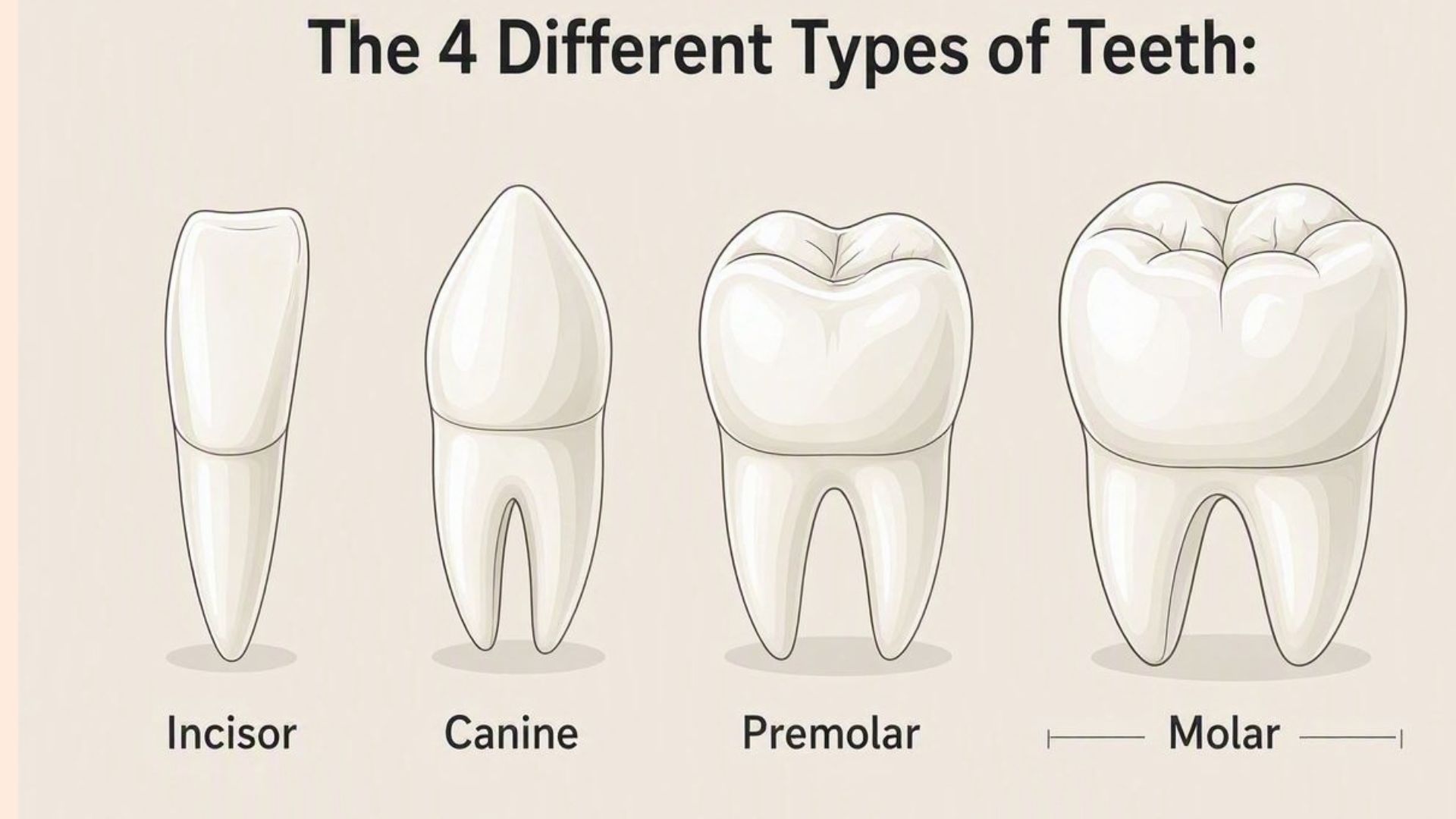
Incisors
Incisors are the 8 teeth located at the front of the mouth, four in the upper jaw and four in the lower jaw. These have relatively sharp edges designed primarily for biting and cutting food. Incisors basically help you to bite food, fruits, and vegetables into smaller pieces and becomes an important first step in chewing and making the food easier to process with other teeth.
Canines
Canines are also known as cuspids, and they have four pointed teeth located next to incisors. They have a long, pointed shape that helps with grasping and tearing food. Canines are particularly useful when eating foods that require more tearing before they can be comfortably chewed and swallowed.
Premolars
The premolars, which are sometimes referred to as bicuspids, lie just in between the canines and molars and do the work that is quite often overlooked but very much essential. Premolars are generally eight in number, four in the upper jaw and four in the lower jaw. One characteristic feature of premolars is their broad and flattened chewing surface. Unlike other types of teeth that use their cutting and gripping action for breaking food, the function of premolars is to crush and grind the food particles and make it easier to digest. In other words, premolars serve as the link between two very different processes performed by the front and rear parts of the mouth.
Molars
Molars are the largest teeth in the mouth, tucked at the very back on both sides. Including the third molars — better known as wisdom teeth — most adults have up to twelve of them.
Because of their wide, ridged chewing surfaces, molars are perfectly shaped for crushing and grinding. This is the stage where food gets broken down into much smaller particles, fine enough to mix thoroughly with saliva and form into a soft, swallowable mass. Without molars doing this final grinding work, food would be far harder to process, both in the mouth and later in the digestive tract.
How Do Teeth Help With Digestion?
Teeth play their biggest role in what’s known as mechanical digestion — the physical breakdown of food through chewing, as opposed to the chemical breakdown that happens later with enzymes and stomach acid.
Here’s how it plays out in practice: incisors make the first cut, canines tear and hold the food in place, premolars start crushing it apart, and molars finish the job by grinding everything into fine particles. Each step increases the surface area of the food, which matters more than people realize — the smaller the pieces, the more thoroughly saliva can coat and interact with them.
Saliva, in fact, is doing quiet but essential work throughout this entire process. It moistens and lubricates the food so it can form into a soft mass, called a bolus, that’s easy to swallow. Saliva also contains an enzyme called salivary amylase, which begins breaking down starches chemically before the food has even left the mouth.
So while it’s tempting to think of teeth as the sole workers of digestion, that’s not quite accurate. Teeth handle the mechanical side — the physical grinding and breaking down — while saliva kicks off the chemical side. Together, they prepare food to be swallowed and passed along the digestive tract, where the real work of nutrient absorption continues.
How the Four Types of Teeth Work Together
Chewing isn’t a random process — it’s a coordinated system where each type of tooth has a specific role:
- Incisors – Cut and bite food into manageable pieces
- Canines – Tear and hold food in place
- Premolars – Crush and break food apart
- Molars – Grind food down into fine, swallowable particles
Each type builds on the work of the one before it, turning a bite of food into something soft and small enough to swallow comfortably and digest efficiently.
Why Healthy Teeth Matter for Digestion
Healthy teeth make it possible to eat a wide, balanced variety of foods without discomfort. When something goes wrong — a cavity, a missing tooth, chronic tooth pain, or gum disease — chewing becomes harder, and people often start avoiding certain foods altogether, sometimes without even realizing it. Over time, that can quietly affect nutrition just as much as it affects comfort.
This is why oral hygiene isn’t just about avoiding cavities or bad breath — it’s tied directly to how well your body processes food from the very first bite. Brushing with fluoride toothpaste, cleaning between teeth daily, eating a balanced diet, and keeping up with regular dental checkups all help preserve the mouth’s natural ability to do its job.
Final Thoughts
Whenever you eat, you depend on a smooth-operating crew of teeth that work in harmony — incisors for cutting, canines for tearing, premolars for crushing and molars for grinding. You can become complacent with this process until a cavity, tooth loss or general wear and tear over time breaks it.
Understanding what each tooth actually does makes it a lot easier to appreciate why dental care matters beyond appearance. It’s not just about a healthy smile — it’s about giving your digestive system the best possible start, one chew at a time.